5 Arizona Things that People Don’t Believe Exist

“Wait…that’s a real thing?!”

People from outside of Arizona have been surprised or skeptical when these 5 things have come up, but they’re all for real.

How many of these have you seen?

image

1. Tumbleweeds – Not just the stuff of western movie lore, they’re actually Russian thistle plants. When they’re alive, they’re green and grow like weeds. The dead, dry ones break off and roll around in the wind. It’s not like I have to stop my car for tumbleweeds rolling across the road every day. But it has happened.

Also, the city of Chandler builds a big tumbleweed tree for the holidays every year.
image

2. Gila monsters – They’re more fat lizards than monsters. Yes, they have a poisonous bite. However, that’s not a big concern, since they’re not particularly quick or aggressive or likely to chase you down (or meet you at the airport). In fact, it’s rare to even see one out and about.

We felt lucky when we spotted a Gila monster sauntering through the shadows at Boyce-Thompson Arboretum.

image

bta-gila-text

3. Desert monsoons – A friend from Taiwan laughed when I mentioned monsoons in Phoenix. While what we call “monsoon season” isn’t what you’d see in South Asia, it comes with bigger storms and more rainfall than we get other times of the year. Sonoran desert storms are dramatic – and beautiful – in their own way with downpours, thunder, lightning, wind, and dust storms (see #4).

image

image

4. Dust storms – If you saw Mad Max Fury Road, that’s not what a dust storm is like inside. Think fog made of sand, and you’ve got the picture. When it’s dry and very windy, blowing dust forms a cloud you can see approaching from miles away. sometimes an eerie orange color in the afternoon light.

image

image

5. Roadrunners – Although they look nothing like the Wile E. Coyote’s nemesis, they are an actual type of bird. That runs. Sometimes on roads.

image

So there you have it: the real story behind Arizona’s mythological-seeming creatures and phenomena, which are, in fact, the real deal.

Of course, the jury is still out on the Phoenix Lights.

sierra-estrella

Photos:

1. Willcox, AZ

2. Tumbleweed Tree, Chandler, AZ

3. Gila monster. Photo by Blueag9. CCL. 

4. Gila monster at Boyce-Thompson Arboretum.

5-8. Phoenix area during monsoon season.

9. Roadrunner. Photo by Ralph Arvesen. CCL.

10. Sierra Estrella Park.

Fall in Sedona

Travel writer Sherry Ott posted a list of “Most Unusual Destinations for Viewing Fall Colors” and suggests “While everyone heads east, why not just head North” to Minnesota or Alaska or across the ocean to walk the Camino de Santiago in Spain or trek the mountains of Nepal.

sedona-fall-7

For travel a little later in the season, you could look another direction: Southwest. Season-seekers in Phoenix are used to heading to Flagstaff and Sedona to get their fall color fix, but Northern Arizona isn’t on the radar for most people.

sedona-fall-6

sedona-fall-2

In Sedona, the fall color is set against the backdrop of its gorgeous red rocks. The peak color is on the later side. A lot of times we’re in Sedona over Columbus Day weekend, when the leaves are just beginning to turn.

sedona-fall-9

sedona-fall-3

Do the leaves change where you live? Have you ever travelled for fall color?

sedona-fall-1


Microblog Mondays: Write in your own space

A Mount Lemmon Trip

mt-lemmon-road

Mount Lemmon doesn’t have a website.

Which, I guess, makes sense, since it’s a mountain. Although that didn’t stop Mt. Rainier or even Camelback. Maybe the difference is that they’re both the main event in their respective parks. Mt. Lemmon, on the other hand, is just one impressive part of the impressive Santa Catalina Mountains and extensive Coronado National Forest.

catalina-hike

It’s right outside Tucson, but, as much as Phillip and I like hanging out in that area, I’ve never been on Mt. Lemmon itself. Tucson is a 1.5 hour drive, and then it takes another hour to wind your way up the mountain, so it kind of requires its own designated trip.

tucson-i10

Which is happening soon, because my dad thought we (he, Mom, Phillip and I) needed to take a day trip before Phillip goes back to grad school and disappears for 9 months / can’t do anything fun / gets much busier.

We decided to go to Mt. Lemmon since my mom hasn’t been there either. We’ll drive around, picnic, and maybe take a hike. But probably a short one, because the elevation at the top is about 9,000 feet. That is significantly higher than Denver. It’s actually closer to La Paz, Bolivia’s 11,000+ feet.

image

Side note: Thinking about this made me wonder about all the high-altitude places I’ve been and how they compare to each other. So I made a little, roughly-to-scale chart. Maybe I’ll do a better one later, where I actually write legibly and measure the lines. Maybe.

Side note to the side note: I’m thinking of titling my chart “Great Heights” or “Altitude is Everything” or “Elevations I Have Known and Loved” or maybe just “Places I’ve Been High.”

Really, the point is that I’m gonna be moving slow up there in the thinner air.

catalina-desert

Driving from the Tucson desert to the pine-covered top of Mt. Lemmon takes you through climate zones equivalent to driving from Mexico to Canada.

catalina-nest

Mt. Lemmon is one of the sky islands, a poetically-named category of mountains in the Southwest U.S. and Mexico that have dramatically different environments than the areas around them. They have remarkable biodiversity, including plants and animals you normally wouldn’t find in the region.

catalina-mt-lion

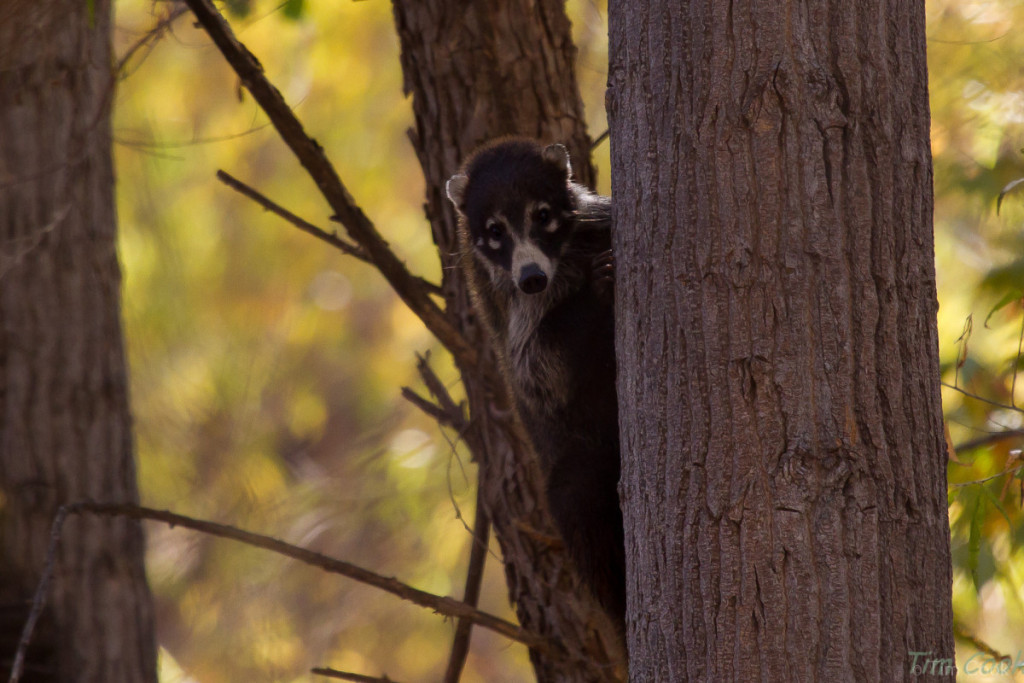
My favorite is the coatimundi, a mammal that’s native to Central America but also inhabits the sky islands. When we went to Chiricahua National Monument (also sky island territory) a few years back, I got kind of obsessed focused on trying to spot one in the wild. It hasn’t happened yet, but, during the trip, I’ll definitely be on the lookout.

image


PS I’ll be posting info from my Craft Camp presentation soon.

Finding wildflowers in the Arizona desert

desert near Superstition Mountains in Mesa

wildflowers-usury-2013

There’s something particularly breathtaking about wildflowers in the Sonoran desert. Maybe because of the way they transform the landscape. Maybe because their season is so brief and precious. Maybe because some years Mexican poppies turn entire hillsides gold, and other years there is only a sprinkling of color. The best years become part of local lore.

wildflowers-usury-2013-2

People try to guess when we’ll have a good year for wildflowers, but they’re hard to predict, like the weather. Actually, it’s the weather for months before wildflower season that has the largest impact on what you’ll see in March.

wildflowers in South Mountain Park, Phoenix, Arizona

Because of their unpredictability, knowing if/when/where wildflowers have arrived depends on someone spotting them and spreading the word – which is much quicker with the internet amplifying the message.

wilfloweers-cottonwood-trip-2013

Where to find Arizona’s spring wildflower sightings online

  • DesertUSA covers regions throughout the Southwest and as far north as Oregon. People submit notes (and sometimes photos) about where they’ve spotted wildflowers. There are also reports from Arizona State Parks, Boyce Thompson Arboretum, and Grand Canyon National Park.
  • The Desert Botanical Garden has a Pinterest map of Arizona wildflower sightings. The DBG itself is a great place to see wildflowers.
  • During the season, Wild in Arizona has more detailed field reports from two nature photographers.

wildflowers-usury-2013-3

Even though it’s early, Phillip and I have already been spotting wildflowers. There were a few as we headed north from town on the 17 over the weekend. A week before that we spotted a single yellow flower while hiking at South Mountain. It might’ve been the first Mexican poppy of the season or an earlier-blooming desert sunflower.

Either way, it looks like it could be a good wildflower year.

wilfloweers-s-mt-2015-2

– More info –

The moon and our shadow

As we watched the lunar eclipse Monday night, I joked with Phillip that I could see our two shadows on top of the earth’s up there too.

moon

We had walked down our sidewalk to get out from behind the trees. A few of our neighbors were already outside, sitting in yards, leaning over balconies, or standing on the sidewalk like us. No one said much. They greeted us or just smiled. One commented “Crazy, huh?” And it was. A lot of the people I used to know have moved out, and I haven’t really gotten to know this new crowd yet. But there we were, hanging out together outside at midnight, craning our necks to watch the shadow of the planet we were standing on eclipse the moon.

I felt a sense of community with our neighborhood that I hadn’t in a long time.

I remember looking at the moon the first time I travelled outside the country. It almost felt strange how it looked exactly the same when so much around me seemed a little off. But there it was, on its journey across the skies of the world, tugging at the oceans, moving through its same phases.

This week a lot of people in a lot of places were looking up at it in the same moment – from sidewalks and balconies, through windows and telescopes – like one huge, sprawling neighborhood.

Whether you saw it or not, we all cast a shadow across the moon.