I’ve paired nine shots of Arizona fall color with Etsy finds that match their autumn vibes! Each pair is a place to go along with fall-inspired decor and other fun stuff.
Every fall, this Chinese Pistache Tree at Boyce Thompson Arboretum turns brilliant shades of orange. You can see it from far away, as it stands out from the green leaves of trees surrounding it.
BTA is a great day trip from the Phoenix area! It’s just about 45 minutes from the East Valley via US 60.
In similarly striking oranges and yellows, you could use these fall foliage stems as part of a flower arrangement or on their own, grouped together to make a standout seasonal centerpiece.
At 24 inches tall, they could really add some height to your Thanksgiving tablescape!
Sourced by BoutiqueBarn + shipping from New Hampshire.
I wasn’t planning on taking a photo of a tree stump while I was admiring the view from Mount Lemmon. Then I noticed teeny – almost cute – little mushrooms growing out of it, and those needed to be captured! Continue reading “Pairings: Arizona Autumn + Fall Decor”
Naturalist, artist, and author Roseann Hanson is an explorer. But her definition of the word doesn’t require you to have traveled extensively on 5 continents the way she has.
To her, being an explorer is more about how carefully you study something – whether it’s the Sahara Desert or a grain of sand – than how far you go. (Incidentally, I agree!)
She gave a talk at the Natural History Institute in Prescott called “The Art of Exploration: How Field Sketching and Journaling Bridge Science, Conservation, and Well-being.”
Krkonoše Mountains drawing by archaeologist Jan Erazim Vocel, c. 1841. Photo via State Regional Archives in Prague + Wikimedia Commons.
Field Note History
In the days before you could just carry a camera with you, it was common practice for scientists and explorers to draw what they were observing out in the world.
Their field notes often included beautiful illustrations, along with handwritten descriptions.
Ancient rock art in Twyfelfontein. Photo by SqueakyMarmot / Mike, Vancouver, Canada – CC BY 2.0
Sketched in Stone
The impulse to make a visual record of what’s around us and what we’ve seen on our journeys goes all the way back to the Stone Age, to cave walls and sandstone boulders. Roseann Hanson sees these drawings as early field notes. Continue reading “Field Notes: Drawing (on) Your Experience”
When the Tucson Gem + Mineral Society held their inaugural show in the 1970s, it was the first of its kind, welcoming both professionals and the public. It continues to be the largest gem and mineral show in the world! Continue reading “10 Things to Know About Gem Shows in Tucson”
Agave has been cultivated in the Tucson area for hundreds of years.
While tequila might be the most widely known product made from agave (a.k.a. the century plant or maguey), it’s certainly not the only one! Different species of the plant are distilled into different spirits, collectively called mezcal.
Native peoples would also use agave to make food, medicine, and even rope. They developed farming techniques to maximize the plant’s adaptability and drought-resistant qualities, so they could grow it where other crops wouldn’t thrive.
Mural of Mayahuel, the agave goddess, by Rock ‘‘CYFI’’ Martinez.
The annual Agave Heritage Festival in Tucson celebrates the plant’s natural and cultural significance. It includes special agave-centered menus at local restaurants, gardening demonstrations, concerts, lectures, mezcal tasting events, hikes to ancient agave roasting pit sites, and a re-creation of the traditional way agave hearts were cooked underground.
After the spring 2020 festival was canceled and last year’s was replaced by a monthly series of virtual talks and DIY tastings, the Agave Heritage Festival made a joyful return this past May!
It has come back as a more compact, focused four days of events – in contrast to the week (or more) it stretched out pre-pandemic.
Following right on its heels was the first annual Pueblos del Maíz Fiesta. The kickoff event for both festivals was a concert by multiple Grammy Award winning Mexican-American singer and activist Lila Downs.
One of this year’s events was the Agave Expo, which included panels, vendors, tables for organizations doing conservation work in Southern Arizona, and a plant sale. It was held on a beautiful morningin Mission Garden, a collection of demonstration gardens where a 17th-century Spanish mission once stood.
Feed the Bats
I arrived right before the first talk of the day, parking next to a woman who was alreadyloadingassorted agave purchases into her car.
“Pollination Nations” was a discussion about agave, bats, and ecology on both sides of the border.
Nectar-eating bats cross-pollinate agaves’ nighttime blooms, creating the genetic diversity essential for the plants’ long-term survival. However, agave planted for human consumption is prevented from blooming. Recent large-scale agricultural methods have lead to hungry bats and a monoculture crop that’s susceptible to disease.
The Bat Friendly project promotes more sustainable practices, encouraging growers to let 5% of the agaves they plant to live out their natural bloom cycle and allow bat pollination. Following their guidelines earns mezcal producers a special Bat Friendly™ label, as well as helping to ensure the continuation of their industry.
The panel discussing these topics was made up of experts from Bat Conservation International, Borderlands Restoration Network, and Sonora Silvestre, as well as mezcal-makers from Bacanora Batuq and Mezcal Zincantan. It was moderated by Jesús García, Research Associate at the Arizona-Sonora Desert Museum and Co-Chair of the non-profit Friends of Tucson’s Birthplace (FOTB).
(Incidentally, Moderator Jesús had returned from a trip to Mexico just in time for the Lila Downs kickoff concert and gave it rave reviews!)
On the Table
Afterwards, I wandered over to the ramada where raspados (snow cones) were being served in hollowed out half lemon peels, in exchange for donations to the garden.
They had three different flavors made from garden produce, and I was not prepared for that kind of decision making. I was especially torn between the refreshing sounding lime-mint flavor and the artisanal agave syrup, which seemed like the most fitting choice for the occasion. Then the volunteer scooping the crushed ice suggested I have both. Sold.
Sprinkled throughout the garden were informational tables and artist booths, including Found Design Sculptures by Leonard Ramirez and Cold Goose Pottery by Judy Ganz.
Found Design Sculptures by Leonard Ramirez
Tucson Audubon Society was there with resources. They were especially highlighting their Habitat at Home program, which shares ways to support birds and other pollinators from your house. One thing they suggest here in Southern Arizona is to leave your hummingbird feeder out on summer nights, because bats might stop by for a drink!
Chocolate Ritual
Before I left, I made a final stop at the Chocolate Ritual booth to pick up some of their mezcal-infused chocolate truffles. They create their chocolates to have a taste that pairs well with either mezcal or coffee. The “ritual” is as simple as sipping your preferred beverage in between bites of chocolate and savoring the combination. It’s a practice I can definitely get behind.
Another agave goddess mural by Rock ‘‘CYFI’’ Martinez!
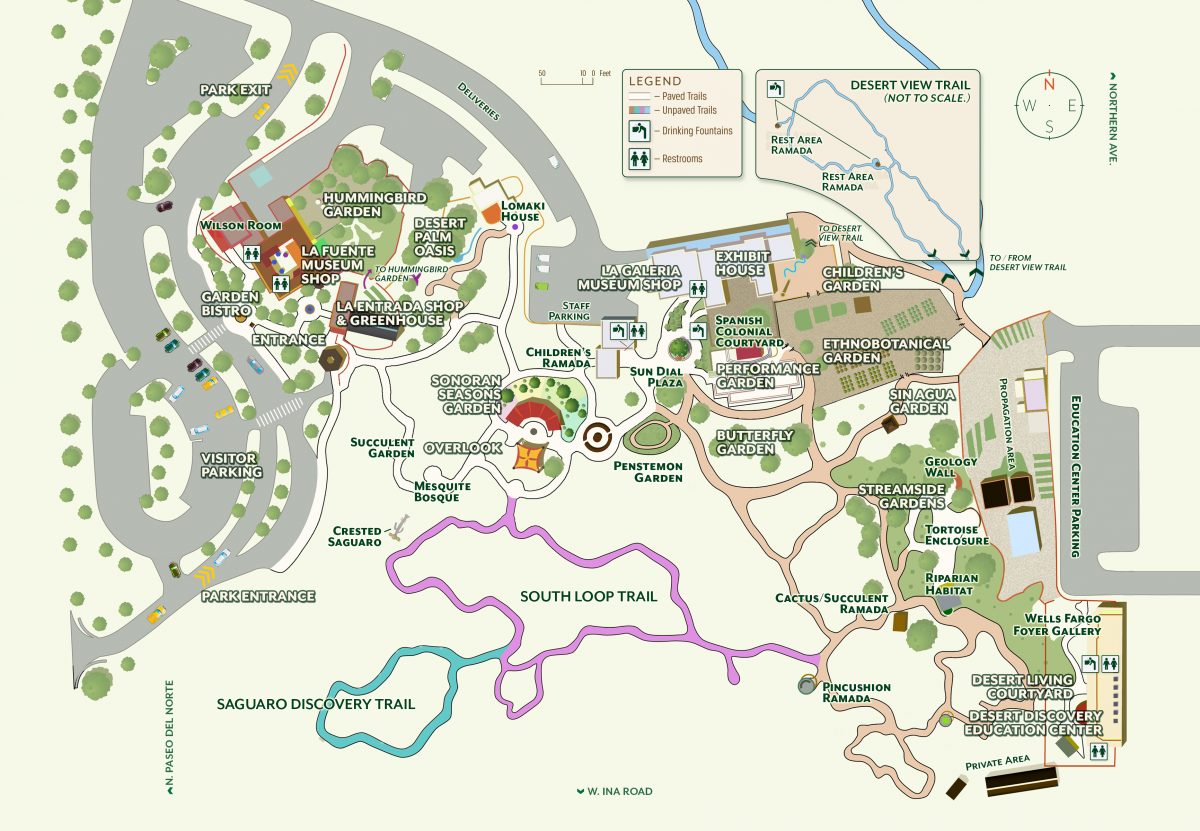
Tohono Chul is a nature preserve just north of Tucson. On its 49 acres, you can find art, shops, gardens, a bistro, and lots of paths winding through the desert.
A Desert Corner
The name comes from the words for “desert corner” in the language of the Tohono O’odham (“desert people”), who were the ancestral inhabitants of this region.
I’d heard about this beautiful place from my Master Gardener uncle long before we moved to Tucson. For awhile I thought it was called “Tohono Jewel.” It is a gem of a place, so that fits too.
Phillip and I finally made it in there when my parents and their friends who were visiting from the Midwest decided to spend a day in Tucson.
They drove down from Phoenix and met us at the entrance on a sunny morning in February 2020 – when we were all blissfully unaware what the next 12 months would bring.
Routes to Drive from Phoenix to Tucson
Tohono Chul is actually in a pretty convenient location for people making the trip south from Phoenix.
There are two main ways to get from the Phoenix area to Tucson:
1. I-10 Freeway (“the 10”)
1.5-hour approximate drive time.
Quickest, most direct route.
Tohono Chul is about 15 minutes east of the 10 (exit at Ina Rd.)
2. Highways / Scenic Route (“the back way”)
2.5-hour approximate drive time.
Slower, more interesting route through Florence to State Route 79 then to Copper Corridor Scenic Road (SR 77).
Tohono Chul is just west of SR 77, so this route practically drops you at its front door.
“Regal Horned Lizard” by Dave Stone.
Art in Nature
Even though the sun was out, it was pleasantly chilly when we arrived. Many of the less cold-tolerant plants in the gardens were covered up because of a freeze warning, draped in sheets like furniture in an unused room of a Victorian mansion.
Part of “Two Cactus Wrens” sculpture by Mark Rossi.
Of course, plenty of the cactus varieties there are unfazed by frost. For example, no one needs to cover 30-foot-tall saguaros. Which is good. They take care of themselves and tend to outlive us humans.
Which brings me to my favorite plant we saw that day: a friendly-looking crested saguaro! Crested saguaros have a rare mutation that causes them to fan out at top.
“Standing Life-size Vulture” sculpture by Kioko Mwitiki.
While we didn’t go into any of the galleries, we did see several outdoor animal sculptures woven throughout the gardens, like a life-sized rusted metal vulture (by Kioko Mwitiki) and a much-larger-than-life horned lizard (by Dave Stone).
During the summer, it would be great to spend the morning exploring outdoor trails and then retreat into the galleries during the heat of the day.
There’s an outdoor geology wall that uses rocks from the nearby Santa Catalinas to illustrate the layers of stone under the mountains.
The Desert Living Courtyard showcases several types of gardens you could DIY with plants that grow well here, including a moorish garden and a “barrio garden” that replicates a backyard garden space with art from upcycled materials. For each garden vignette, there’s a list of plants and materials you could use to recreate it.
More Tucson Gems
After Tohono Chul, we ate lunch at the nearly 100-year-old restaurant El Charro. While there is a much closer location in Oro Valley, we opted to go to the original old building in Downtown.
It was the time of year where the Tucson Gem & Mineral Show® happens at the Tucson Convention Center. If you don’t have time for the massive, main show, you can get kind of a sampling at dozens of smaller gem shows that spring up around it.
I knew that we’d be in walking distance of Hotel Tucson City Center, which had its own free, open-to-the public show with 300 vendors selling minerals and fossils on their property.
Before our guests returned to Phoenix, we took a drive around Downtown, stopping for ice cream at HUB.
Everything Changes
I’m extra grateful we happened to go on that day a year ago, just before a certain coronavirus would shut everything down, when 2020’s dumpster fire was only a spark.
After being closed for months, Tohono Chul has reopened 7 days a week with pandemic precautions in place (details below).
Many Downtown Tucson restaurants are open for takeout. El Charro is celebrating its 99th anniversary with a special menu. HUB Ice Cream Parlor has remodeled and now has a walk-up window.
On a more personal note, my parents’ Midwestern friends were getting ready to launch their annual winter visit, when my dad received a cancer diagnosis and found out he would need major surgery right away.
It has all given him – and us – a new perspective.
After coming through his surgery successfully, he made himself a rule to focus on the moment we have now. It’s a good thing to practice.
Treasure your corner of the desert.
– More Tohono Chul info –
Not to be confused with Tucson Botanical Gardens (which is a collection of urban gardens in the middle of town).
Instead of buying admission tickets at the Park, you purchase tickets for a specific time online in advance.
Shops and Garden Bistro have reopened with limited capacity.
Masks are required. If you forget yours, you can call from the parking lot and they’ll bring one out to your car.
B.Y.O.B.: bring your own (water) bottle! Drinking fountains are currently off-limits, but there are hands-free water bottle refill stations available.
If you’re not ready to go in person, there are lots of videos and resources to enjoy Tohono Chul @ Home.
Manage Cookie Consent
To provide the best experiences, we use technologies like cookies to store and/or access device information. Consenting to these technologies will allow us to process data such as browsing behavior or unique IDs on this site. Not consenting or withdrawing consent may adversely affect certain features and functions.
Functional
Always active
The technical storage or access is strictly necessary for the legitimate purpose of enabling the use of a specific service explicitly requested by the subscriber or user, or for the sole purpose of carrying out the transmission of a communication over an electronic communications network.
Preferences
The technical storage or access is necessary for the legitimate purpose of storing preferences that are not requested by the subscriber or user.
Statistics
The technical storage or access that is used exclusively for statistical purposes.The technical storage or access that is used exclusively for anonymous statistical purposes. Without a subpoena, voluntary compliance on the part of your Internet Service Provider, or additional records from a third party, information stored or retrieved for this purpose alone cannot usually be used to identify you.
Marketing
The technical storage or access is required to create user profiles to send advertising, or to track the user on a website or across several websites for similar marketing purposes.


_(cropped).jpg)